What Is CO₂ Fractional Laser Resurfacing?
If fine lines, sun damage, acne scars, uneven texture, or signs of aging are becoming more noticeable, CO₂ fractional laser resurfacing is one of the more intensive skin-resurfacing options available.
At Englewood Cosmetic Medical Spa in Englewood, NJ, we use fractional CO₂ laser treatments to address damaged skin while stimulating the body's natural healing and collagen-remodeling process.
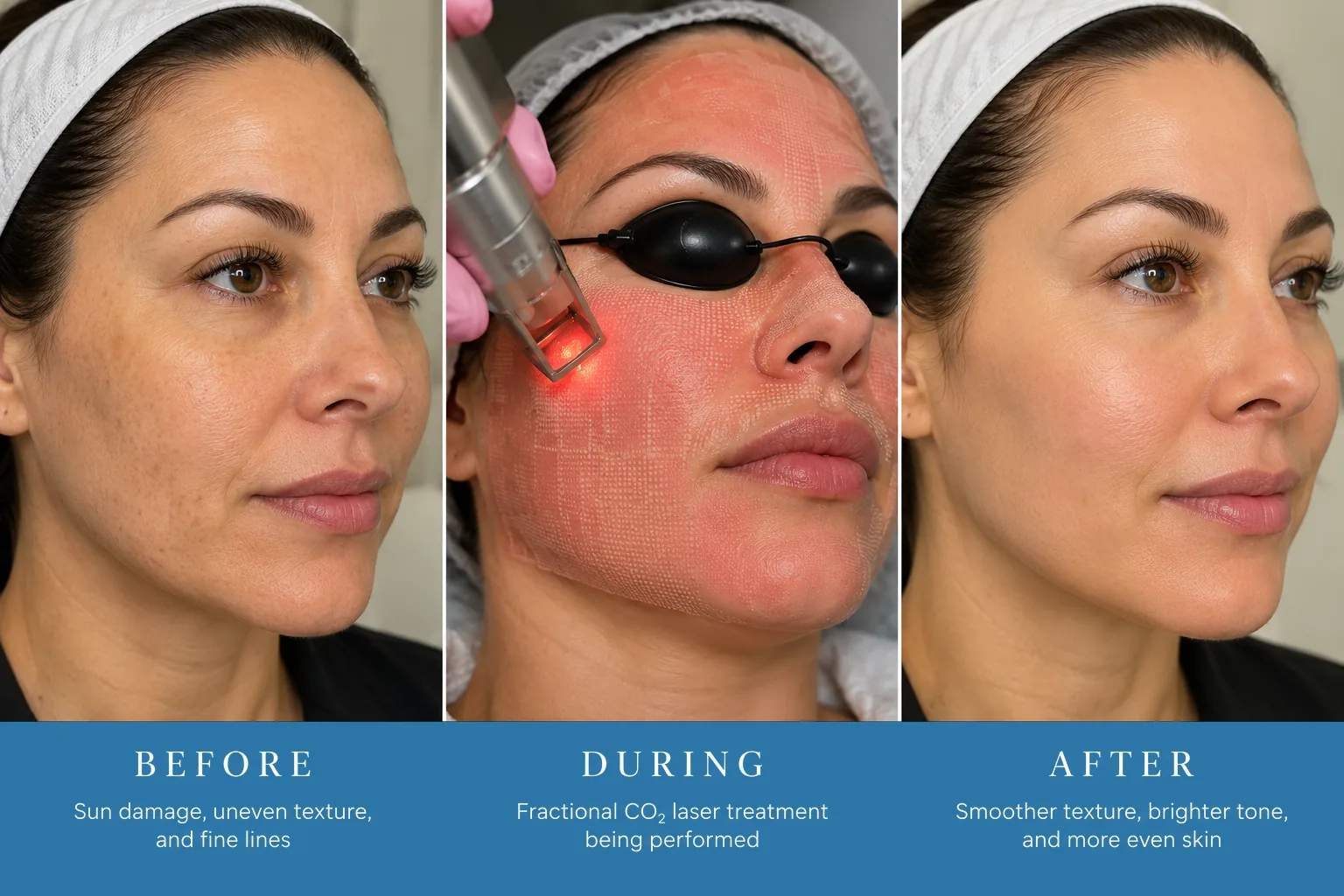
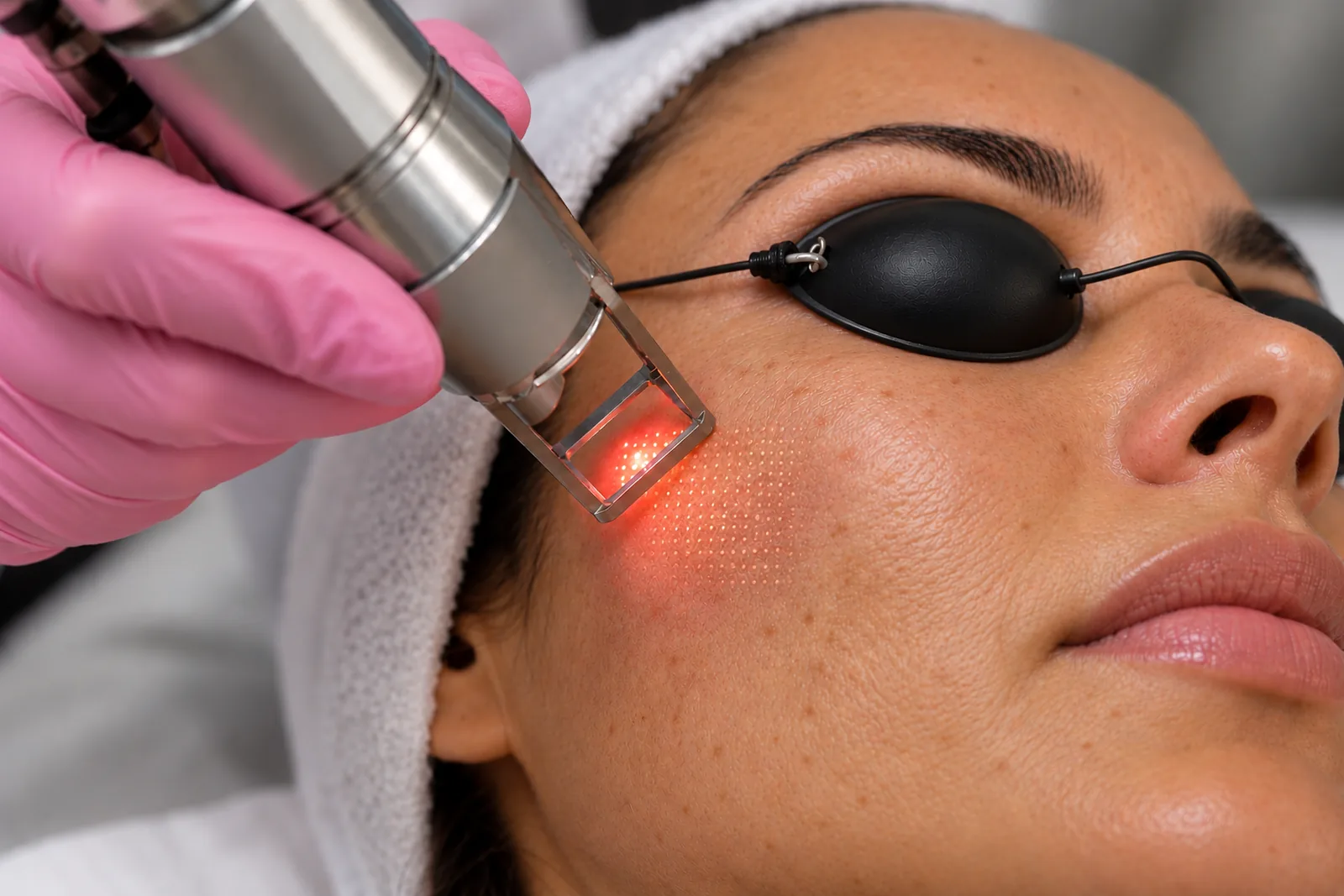
Unlike treatments that work primarily on the surface of the skin, a CO₂ laser delivers controlled laser energy into targeted areas of the skin. With fractional treatment, microscopic columns of treated tissue are created while surrounding areas of skin remain intact.
This fractional approach allows the skin to begin repairing itself while encouraging the production and remodeling of collagen.
The result is not simply exfoliation. CO₂ resurfacing is designed to create progressive improvement in skin texture, tone, fine lines, and certain types of scarring as the skin heals.
What Can CO₂ Fractional Laser Treat?
One reason patients consider CO₂ laser resurfacing is its ability to address several skin concerns during the same treatment.
Depending on your skin, treatment settings, and individual goals, fractional CO₂ laser may help improve:
- Fine lines and wrinkles
- Sun-damaged skin
- Uneven skin texture
- Certain types of hyperpigmentation and discoloration
- Acne scars
- Enlarged-looking pores
- Rough or crepey skin
- Overall skin tone and texture
- Signs of photoaging
It is particularly useful for patients looking for a more significant resurfacing treatment than a light facial or superficial peel.
However, CO₂ laser is not appropriate for every patient or every skin concern. Your skin type, pigmentation, medical history, medications, history of scarring, recent sun exposure, and treatment goals should all be considered before treatment.
How Does a Fractional CO₂ Laser Work?
CO₂ lasers use a wavelength of approximately 10,600 nm, which is strongly absorbed by water in the skin.
The laser creates controlled microscopic treatment zones in the skin. This triggers a wound-healing response that contributes to resurfacing and subsequent collagen remodeling.
Think of the treatment as creating thousands of precisely controlled microscopic treatment areas rather than removing the entire surface of the skin uniformly. The surrounding untreated tissue helps support the healing process.
Over the weeks and months following treatment, collagen remodeling can continue, which is why the final result of a CO₂ treatment should not be judged immediately after the skin heals.
What Happens During a CO₂ Laser Treatment?
Your treatment begins with a consultation and skin assessment.
We discuss what is bothering you, previous treatments, medical history, medications, sun exposure, tendency toward hyperpigmentation or scarring, and what you realistically hope to accomplish.
If CO₂ resurfacing is appropriate for you, a treatment plan is developed based on your skin and goals.
Before the procedure, the skin is thoroughly cleansed and appropriate comfort measures are used. Protective eyewear is required during laser treatment.
The CO₂ laser is then passed systematically over the treatment area using settings selected for the individual patient and treatment goal.
Treatment intensity is not one-size-fits-all. More aggressive settings are not automatically better. The goal is to use an appropriate treatment level while balancing results, recovery, and the patient's individual risk factors.
Does CO₂ Fractional Laser Hurt?
CO₂ resurfacing is a more intensive procedure than many non-ablative facial treatments, so patients should expect some discomfort.
Comfort measures may include topical anesthetic and other options depending on the extent and intensity of treatment.
During treatment, patients may experience sensations of heat, warmth, or stinging. Afterward, the skin can feel similar to a significant sunburn, particularly during the early recovery period.
What Does Your Skin Look Like Immediately After CO₂ Laser?
Immediately following treatment, redness, warmth, swelling, and sensitivity are expected.
The skin's appearance during recovery depends heavily on how aggressively it was treated.
During the first several days, you may experience redness and swelling followed by dryness, roughness, bronzing, flaking, or peeling as the treated skin heals.
This is an important distinction for patients considering CO₂ resurfacing: this is not typically a no-downtime treatment. You should plan your procedure around work, social events, travel, and other commitments.
How Much Downtime Should I Expect?
Downtime varies considerably according to treatment depth and intensity.
For some fractional treatments, the most noticeable initial recovery may occur over approximately 5–7 days, but redness or pinkness can persist longer. More aggressive resurfacing can require a longer recovery period.
Rather than promising every patient the same number of downtime days, we recommend planning your treatment around your individual treatment intensity and expected healing response.
This is especially important if you have an upcoming wedding, vacation, photography session, or major event.
CO₂ Laser Aftercare: What Should You Do?
Aftercare is a major part of a successful laser-resurfacing treatment.
Your skin barrier is temporarily compromised after treatment, so the skin needs to be treated gently while it heals.
Patients are given individualized post-treatment instructions, which may include gentle cleansing, keeping the skin appropriately moisturized, avoiding picking or peeling, and temporarily avoiding irritating skincare products.
Ingredients such as retinoids, exfoliating acids, scrubs, and other potentially irritating products should generally not be restarted until your provider determines that your skin has healed sufficiently.
Sun Protection Is Especially Important
Freshly treated skin is particularly vulnerable to ultraviolet exposure. Avoid unnecessary direct sun exposure during recovery and follow your provider's instructions regarding sun protection.
Long-term sun protection is also important because continued UV exposure contributes to the same photoaging and pigmentation that many patients are trying to improve with laser treatment.
When Will I See Results From CO₂ Fractional Laser?
CO₂ laser results develop in stages.
Once the initial healing, flaking, and redness begin to resolve, patients may start noticing smoother and fresher-looking skin. However, that is only part of the process.
Because fractional CO₂ treatment stimulates a healing and collagen-remodeling response, improvement can continue over the following weeks and months.
Depending on the condition being treated, patients may notice progressive improvement in texture, fine lines, skin quality, or the appearance of certain scars.
Results vary, and no laser treatment can guarantee perfectly smooth or flawless skin.
How Many CO₂ Laser Treatments Will I Need?
There is no universal number.
Some patients may choose a more intensive treatment, while others may benefit from a series of more conservative treatments. The appropriate approach depends on your skin, concern, desired result, tolerance for downtime, and treatment settings.
For deeper wrinkles or acne scarring, combination treatment may also be considered rather than relying on CO₂ laser alone. Depending on the type of scar or skin concern, a treatment plan could incorporate microneedling, RF microneedling, subcision, injectables, or other skin-rejuvenation procedures.
A consultation allows us to determine which approach makes the most sense for your skin rather than simply choosing the most aggressive treatment available.
Is CO₂ Laser Good for Acne Scars?
Fractional CO₂ laser can be an effective option for improving the appearance of certain atrophic acne scars and uneven skin texture.
However, acne scars are not all the same. Rolling, boxcar, and ice-pick scars have different characteristics and may respond differently to treatment. Some tethered scars, for example, may require another procedure such as subcision as part of a comprehensive treatment plan.
This is why an acne-scar consultation should involve examining the type and depth of the scars, not simply deciding that every scar needs a laser.
Can CO₂ Laser Be Used on Darker Skin Tones?
This requires careful patient selection.
Laser resurfacing can cause pigmentary changes, including post-inflammatory hyperpigmentation or hypopigmentation, and these risks can be particularly important in patients with more melanin-rich skin.
Having a darker skin tone does not automatically answer whether someone is or is not a candidate. A proper evaluation should consider skin type, pigmentation history, sun exposure, previous procedures, treatment area, settings, and the patient's individual risk factors.
In some cases, another resurfacing or rejuvenation treatment may be more appropriate.
CO₂ Laser vs. Microneedling: Which Is Better?
Neither treatment is universally "better." They serve different purposes.
Microneedling creates controlled mechanical micro-injuries and generally involves less downtime. It can be useful for texture, mild scarring, and overall skin rejuvenation.
Fractional CO₂ laser provides ablative laser resurfacing and may be considered when a patient wants more significant improvement in concerns such as photoaging, wrinkles, texture, or certain acne scars and is comfortable with greater downtime.
For some patients, the best long-term plan may involve more than one treatment modality.
Who Is a Good Candidate for CO₂ Fractional Laser?
You may be a potential candidate if you are bothered by wrinkles, sun damage, uneven texture, acne scarring, or other signs of photoaging and understand that meaningful resurfacing generally involves some recovery.
A consultation is especially important if you have a history of:
- Hyperpigmentation after procedures
- Keloid or abnormal scarring
- Cold sores
- Recent tanning or significant sun exposure
- Certain skin conditions
- Recent aesthetic procedures
- Medications that may affect healing
Always provide your provider with an accurate medical and medication history before undergoing laser treatment.
Why We Don't Believe in One-Size-Fits-All Laser Treatments
Two people can walk into our Englewood medical spa asking for a CO₂ laser and need completely different treatment plans.
One patient may primarily have fine lines and sun damage. Another may have acne scars. Another may be concerned about texture but have a skin type that requires a more conservative approach.
That is why we start with the patient, not the machine.
The goal is not to perform the strongest possible laser treatment. The goal is to determine which treatment—and which level of treatment—makes sense for your skin, your goals, and the amount of downtime you are comfortable with.
CO₂ Fractional Laser in Englewood, NJ
If you're considering CO₂ fractional laser resurfacing in Englewood or Bergen County, NJ, the first step is a consultation.
At Englewood Cosmetic Medical Spa, we'll evaluate your skin, discuss your concerns and previous treatments, and determine whether CO₂ laser resurfacing—or another skin-rejuvenation option—is appropriate for you.